
Projected vs Actual Release Date
A projected release date is an estimate or sentence-administration calculation. An actual release date is the date the person left a specific custody system. Monroe County jail records may show a release date and release reason such as bond, court order, time served, transfer to ADOC, transfer to another county, federal hold, immigration hold, or dismissal/no further hold. ADOC projected dates are different because they are calculated after a state sentence is received and administered.
Scheduled vs actual release. The research supports the phrase "projected release date" from ADOC public handbook material describing an inmate time sheet. That does not mean the public ADOC search exposes the field on every record or that the projected date is guaranteed. A confirmed release usually requires a release/discharge record, custody-status update, ABPP status, VINE/VNS notification, or direct custodian confirmation.
For a pretrial Monroe County detainee, do not look for an ADOC projected release date unless the person has been sentenced or transferred to state custody. A person who posts bond at the county level may leave the Monroe County Detention Facility and never become an ADOC inmate. A person sentenced to county time may also remain a local jail records question rather than a state-prison date question.
The release reason is the field that prevents confusion. A county record showing "transfer to ADOC" points to state sentence administration after the local jail exit. A record showing bond, recognizance, court order, time served, or dismissal/no further hold points back to the sheriff and court record. The same calendar date can mean very different things depending on which custody system changed status.
How to Find a Monroe County Inmate's Projected Release Date
Begin by deciding whether the person is in county jail, state prison, or a post-release supervision process. The wrong system will produce a misleading answer. Monroe County has no ADOC state prison facility identified in the research, so ADOC is used for people sentenced to state custody, not for every person arrested in the county.
- For a county jail release, call the Monroe County Detention Facility at 251-575-2635 and ask whether the person is currently in custody, released, transferred, or never booked.
- Ask for the release date, release time, release reason, and receiving agency if the person was transferred out of Monroe County custody.
- Check the Monroe County Circuit Clerk or Alacourt for the sentencing order, case status, disposition, jail credit, court actions, and any later modification.
- For a state prisoner, use the ADOC inmate search by first name, last name, or AIS number. ADOC says name fields may be used separately or together and that name searches are open-ended.
- If the public ADOC result does not show the needed projected-date detail, use ADOC records channels. ADOC lists a Public Records Coordinator at public.records@doc.alabama.gov and 334-353-3883, and its public-records form requires a non-refundable $20 processing fee.
- If parole or mandatory supervision may affect the date, check ABPP FAQs, scheduled hearing pages, hearing results, and the Monroeville Field Office.
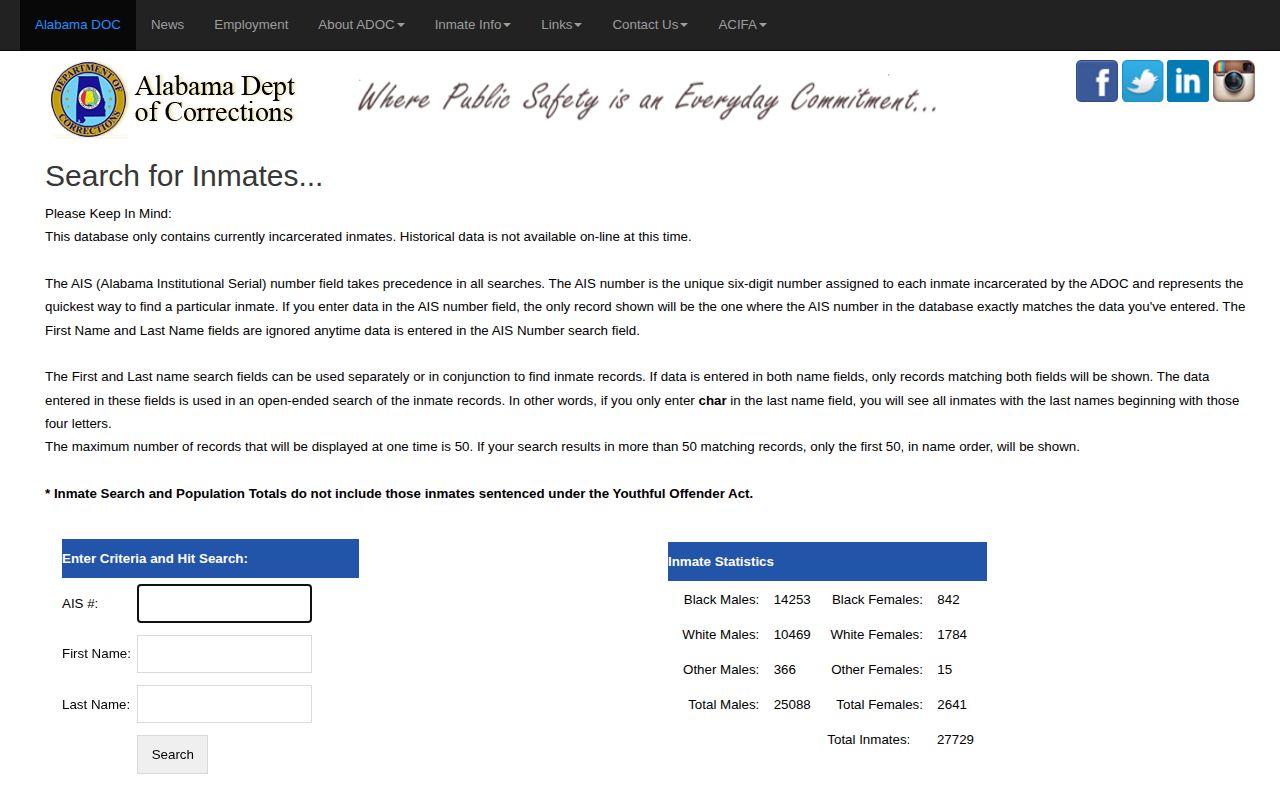
Search failures should be interpreted carefully. ADOC says first and last name fields can be searched separately or together, and name searches are open-ended. Try the AIS number if available, then a last-name-only search if spelling or hyphenation is uncertain. A missing ADOC result does not prove the person was never in Monroe County custody, because county jail bond releases, some county sentences, and municipal citation releases may never become ADOC records.
Good-Time Credit and Alabama Release Dates
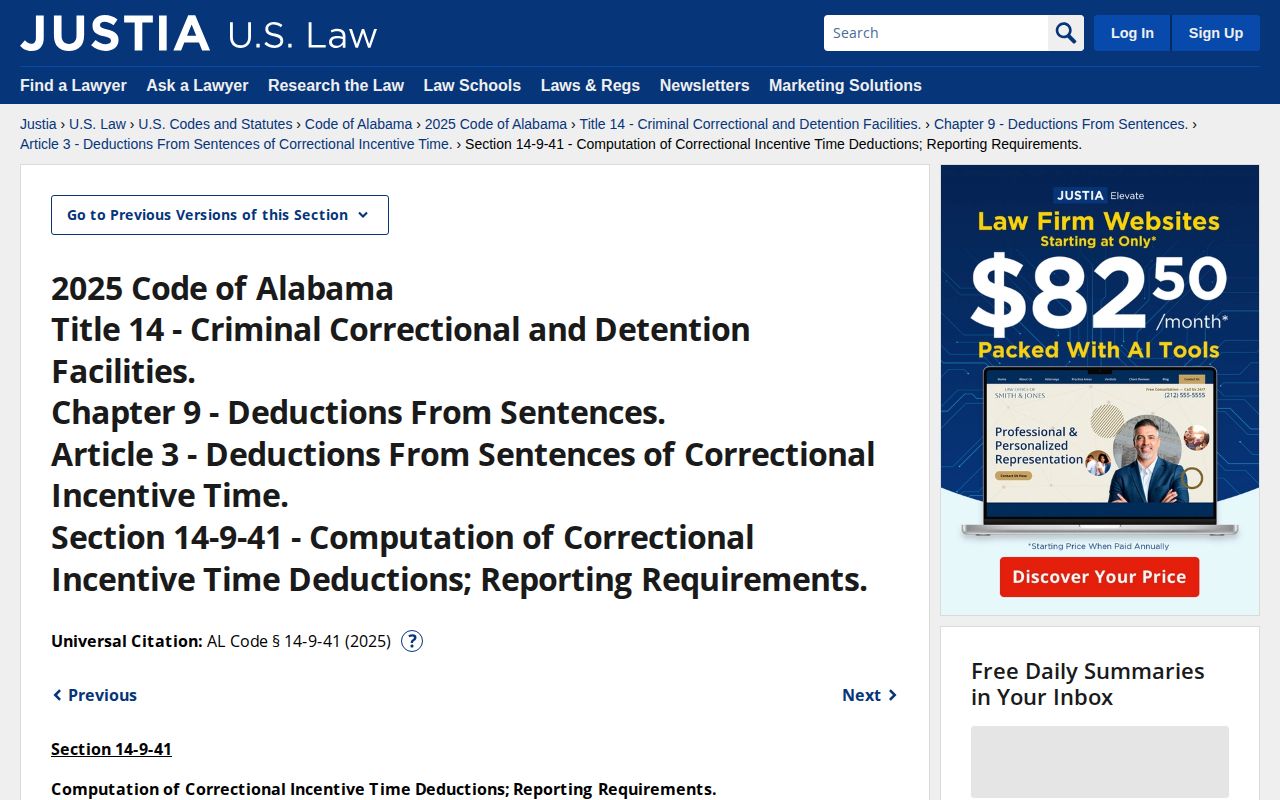
Alabama Correctional Incentive Time is governed by Ala. Code Section 14-9-41. The statute creates earning classes, including Class I, Class II, Class III, and Class IV. Class IV is flat time or day-for-day and receives no correctional incentive time. The statute also excludes listed categories of prisoners, including Class A felony convictions, crimes causing death by deadly weapon, life/death sentences, sentences over 15 years, and sex offenses involving a child, among other restrictions.
This is why a sentence length alone is not enough to calculate the date from the outside. The same Monroe County sentencing order may produce different practical dates depending on whether the person is eligible for incentive time, how ADOC classifies the person, whether education incentive time applies, and whether later discipline, court action, or supervision rules change the calculation.
Education incentive time is governed by Ala. Code Section 14-9-64. The research notes that education incentive time can be in addition to other available sentence deductions, including correctional incentive time under Section 14-9-41. These statutes explain why two people sentenced in Alabama for similar time periods may have different projected dates. The public page can explain the categories, but ADOC owns the calculation for an individual state sentence.
Inputs Behind an ADOC Projected Date
The supported Monroe County workflow is to gather the records that feed the state calculation. The court case supplies the sentence, conviction, jail credit, split-sentence terms, and later orders. ADOC administers the state sentence after reception and classification. ABPP may affect parole eligibility or mandatory supervision. The release date should not be reduced to one search box when the underlying record chain has several custodians.
| Input | Why it matters |
|---|---|
| Sentence imposed | The Monroe County court order sets the legal sentence ADOC must administer. |
| Jail credit | ABPP FAQs identify jail credit as a factor in eligibility calculations, and it can affect sentence administration. |
| Correctional incentive time | Section 14-9-41 can move a projected date for eligible prisoners, while excluded prisoners may serve flat time. |
| Education incentive time | Section 14-9-64 may create additional sentence deductions when the person qualifies. |
| Parole eligibility | Eligibility or a set date is a consideration point, not automatic release. |
| Mandatory supervision | Section 15-22-26.2 can create release to supervision before final sentence expiration for qualifying inmates. |
Why a Projected Release Date Changes
A projected date can move because it is a living calculation until release actually happens. The research identifies multiple Alabama-specific reasons: incentive-time eligibility, disciplinary or classification changes, sentence modifications, jail-credit issues, parole decisions, mandatory supervision rules, and holds or transfers.
| Factor | Effect on the date |
|---|---|
| Discipline or classification | Can affect correctional incentive time and therefore the projected release calculation. |
| Statutory exclusions | Some prisoners cannot earn correctional incentive time because of offense, sentence, or statutory category. |
| Court orders | Sentencing, modification, jail credit, or split-sentence orders can change the legal inputs. |
| Parole decision | A grant, denial, or continuance changes the practical release path but is not the same as end-of-sentence calculation. |
| Detainers or transfers | A person may leave one custody system and enter another, so the release record must state destination. |
| Mandatory supervision | Qualifying inmates may leave custody under supervision before final sentence expiration. |
Parole Eligibility Is Not Release
ABPP's parole FAQs say eligibility consideration is calculated under Ala. Code Section 15-22-28(e), and that sentence, crime, jail credit, ability to earn good time, time served, and court orders can affect eligibility. Once eligibility is calculated, the inmate may receive a letter with a parole consideration eligibility date or set date by month and year. That date means parole consideration, not guaranteed release.
Ala. Code Section 15-22-26 says parole release is not merely a reward for good conduct. The Board must be of the opinion that the prisoner meets board criteria, guidelines, and public-safety standards. For a Monroe County conviction that resulted in ADOC custody, use ABPP scheduled hearings and results to understand the parole path, then confirm any supervision through the Parole & Probation page's local office details.
Do Not Assume an 85 Percent Rule
Alabama should not be summarized as a simple "everyone serves 85 percent" state. The research found special parole-eligibility rules for certain serious Class A felonies after March 21, 2001, including guide material describing 85 percent or 15 years, whichever is less, for some cases. But many release-date outcomes are controlled by specific offense category, sentence length, good-time eligibility, statutory exclusions, disciplinary history, parole law, mandatory supervision, and court orders. The accurate Monroe County answer is to verify the actual sentence and the agency calculation.
County Jail Release Dates Are Events
A Monroe County jail release date is usually a recorded event, not an ADOC sentence projection. The Monroe County Detention Facility can record whether a person left because bond was posted, a court ordered release, time was served, charges were dismissed, the person was transferred, or another hold controlled the next step. No Monroe County-specific county-jail good-time policy or weekend-release policy was identified, so this page does not invent local timing rules. Confirm county-sentence releases directly with the detention facility or the sentencing court.
Confirming a Release Date
Use notifications as alerts and records as proof. Alabama VINE and Alabama VNS can help monitor covered custody-status changes, especially ADOC/post-conviction matters. Alabama VNS says it is for people convicted in Alabama and sentenced to prison, and directs users with cases not yet tried to contact the sheriff in the county where the crime occurred. That warning matters in Monroe County because a local jail release may require the sheriff or detention facility even when a state notification system exists.
For a document, request the custodian's record. Monroe County jail release details belong to the sheriff/detention facility. State-prison projected-date and discharge records belong to ADOC. Parole and mandatory supervision records belong to ABPP. Court sentence and disposition records belong to the clerk and Alacourt system. A projected date becomes a reliable release fact only after it is matched to an actual custody-status change or custodian-produced record.
If the question is urgent because a date is approaching, ask the current custodian what record or notification confirms the change. For Monroe County jail custody, that means the detention facility or sheriff. For ADOC custody, that means ADOC records or the public search when it displays the relevant field. For supervision after release, that means ABPP and the Monroeville Field Office.
Alabama Calculation Quirks
The distinctive issue for Monroe County is that the phrase "projected release date" belongs mainly to Alabama state sentence administration, while a Monroe County jail release date is a local event. ADOC handbook material uses "projected release date" for the time sheet. Alabama statutes then layer correctional incentive time exclusions, education incentive time, parole eligibility, and mandatory supervision over the court sentence. That is why the page should not send every user to one roster. It should route county jail releases to Monroe County records and state-prison projections to ADOC, ABPP, and the sentencing record.